

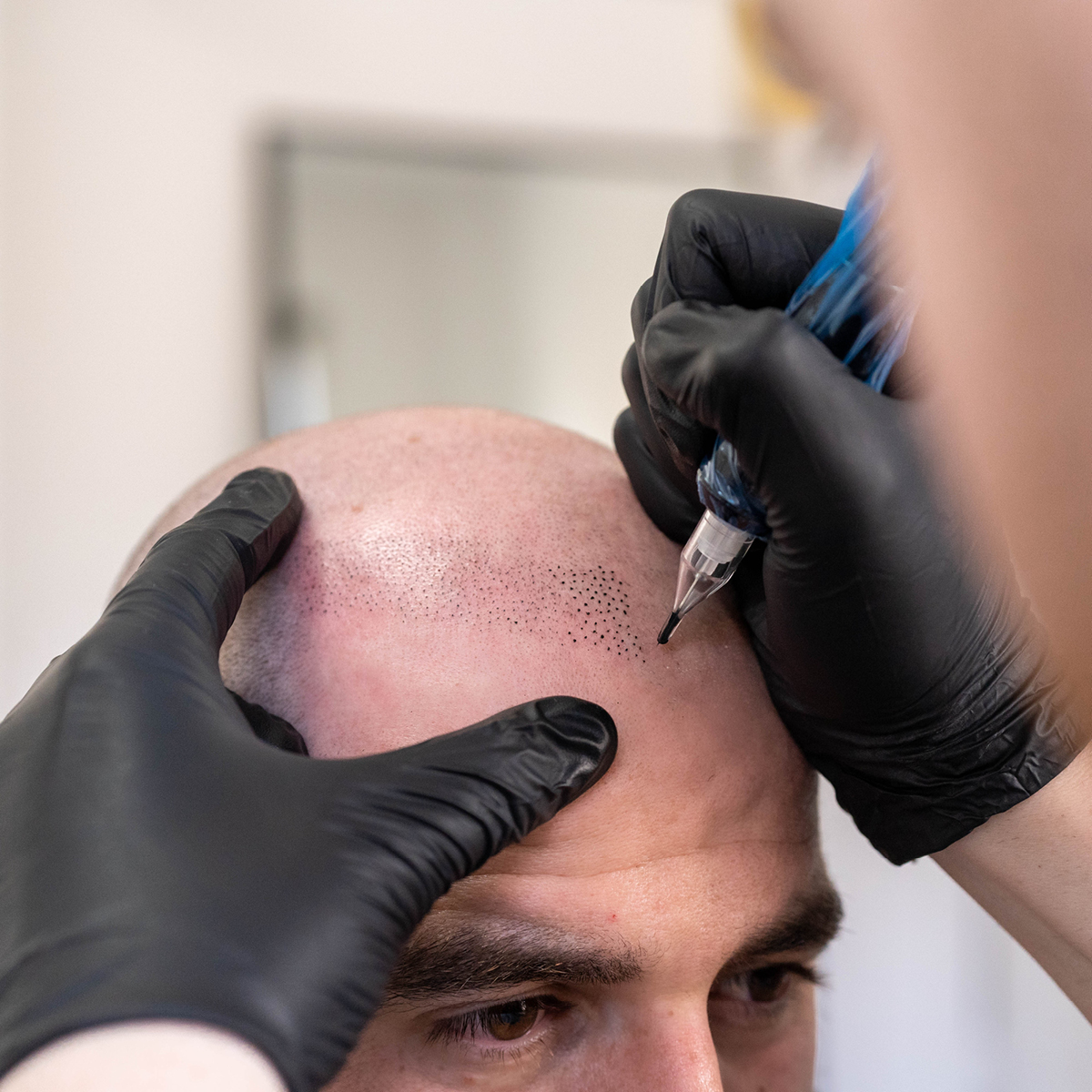
Scalp Micropigmentation is a non-surgical method of inserting organic plant-based pigment deposits through the dermal layer of the scalp. The pigment deposits replicate hair follicles and create the appearance of a full head of hair. If you are completely bald, we provide the 5 o’clock shadow look; and if you are thinning or not satisfied from hair transplant results and require more density, SMP is for you.
Do I need to take time off work?
Do I need to take time off work?

SMP Aftercare
SMP Aftercare
Does SMP hurt?
Does SMP hurt?
How many treatments do I need?
Scalp Micropigmentation always takes a minimum of two treatments, both treatments one week apart. Reason being, we are working with your skin (the largest organ on the body) to accept our procedure; the human skin will reject some of the pigment immediately after the first treatment. We expect to see significant results after the first treatment but the second treatment will refine and complete the look. There is a possibility of a third treatment within the first 3 months after the second treatment where we add the finishing touches.
How long is each treatment?
Each session is 2-4 hours depending on the work at hand. The first treatment is typically the longest as we are constructing the hairline and putting in the foundational layer. Each subsequent treatment is typically shorter, although this can vary based on retention of previous treatments.
Who decides on the construction of the hairline?
There are factors that determine what hairline is suitable for you. We tailor the hairline to your individual features in order to create the most natural and appropriate result. We also account for your personal preferences, as there is a range of options for what can look natural on any given person.
I've already had 3 treatments, now what?
After following the initial aftercare instructions, sit back and enjoy the SMP treatment. SMP HQ offers a three month guarantee with our treatment plans so in case there is some lightening of the pigments, you have our guarantee that we will touch it up on us. After that, we would suggest having a touch up within the 5-8 years. This is a permanent procedure which will last forever, but the natural exfoliation process of the skin and continuous sun exposure will cause your SMP to lighten slightly over time.
What are the aftercare instructions?
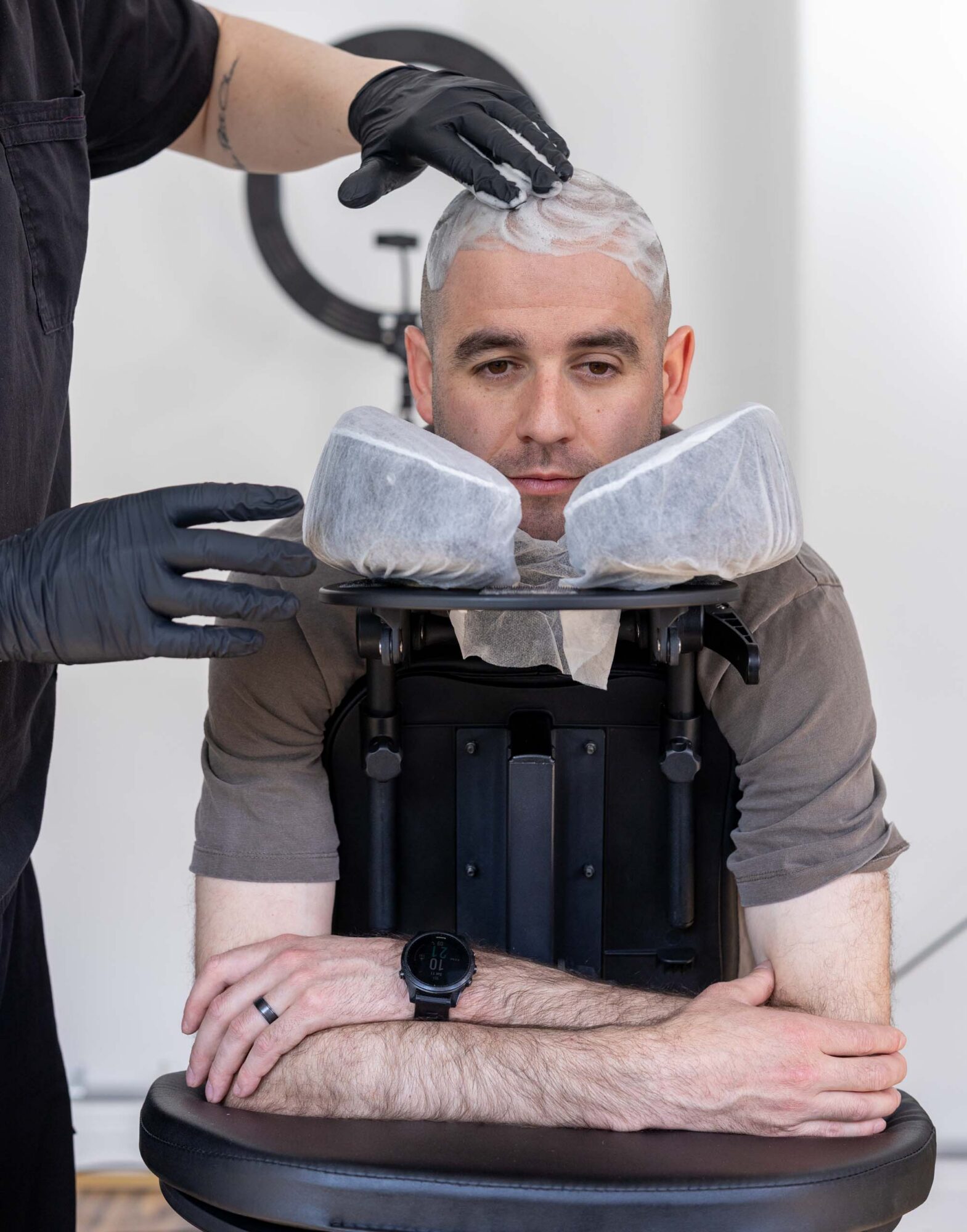
It is crucial you follow our 4 day post-treatment instructions to prevent excessive fading and all forms of contamination. Essentially the instructions are no touching, washing, cutting your hair, and no working out for the first 4 days. You can wear a hat immediately after each treatment. Don’t worry about sleeping on it, the pigment won’t smudge or smear on your pillows.
Do I need to take time off from work?
Scalp Micropigmentation is non-invasive and non-surgical. There is no downtime associated with it, and you only need to follow the 4 day aftercare instructions that are discussed before each treatment. The majority of clients come in for treatment then start work again the following day.
Will people be able to tell I have the treatment done?
Initially after the first treatment the pigments will look bolder as they are freshly deposited. Overnight you will notice the pigments softening and settling down. As for the redness, it will disappear in 24-72 hours. Intensity of redness is based on sensitivity of the skin, but more or less clients will notice significantly less redness 48 hours after the first treatment. After the initial settling process is finished, your treatment will look completely natural.
Does it hurt?
For most clients who undergo SMP, the pain is significantly less to a traditional tattoo. Pain tolerance varies with each client and many feel a slight tingle, some even fall asleep! That being said your health and safety is our priority and we will ensure the process goes as smooth as possible.
Do I need to keep the shaved look?
We will assess your hair loss during the consultation. Once we get an understanding of what class of hair loss you fall under, we provide a treatment plan with the style and look we recommend that would be optimal with our SMP procedure.
Clients classified as Norwood 6-7 hair loss need to maintain a shaved look due to the amount of coverage we have created on top of your head with SMP. As the hair on the back and sides keeps growing, the treatment will become more apparent as there is a visible contrast between your hair and the SMP. This is ultimately a permanent cosmetic procedure in which we are replicating hair follicles with pigmentation, which will never grow or create a 3D texture.
Adding density to an existing hairline and/or density to the crown is classified as a filler treatment. Good candidates for filler treatments are those who still have some hair around the area for us to blend the SMP in with.
Do you also do scar concealment?
You bet! It is also used to conceal scars from previous surgeries or injuries. Both FUE and FUT transplant scars can be concealed with SMP.
Do I need to cut my hair before the SMP treatment?
If we are doing a filler treatment or scar concealment, we typically request our clients to come in with the shortest hair length they are going to keep, unless requested otherwise. If you have class 6 or 7 hair loss, you would need to shave your head before you come in for treatment and maintain it at that length.
Will it affect the treatment if I continue to shave my head?
You can shave and wash your head every day and the treatment will not be damaged as it is in your epidermis layer. As a matter of fact, the majority of our clients who have this procedure shave every day!
How do I best protect my SMP from sunlight?
Overexposure to direct sunlight can cause the pigments to weaken, and overtime you will be damaging both the treatment and your scalp. Wear protective sunscreen or a hat whenever you are going out.
How much does it cost?
Cost for SMP is case by case, depending on the scale of hair loss and the amount of work needed. A guide of what you might expect to pay is:
– Scar treatments $1,200-$2,200
– Added density $1,500-$2,500
– Full head $2,000-$3,500
What does bad SMP look like?
Bad SMP is usually easy to spot once you know what to look for.
Common signs include:
- Hairlines that are too straight or too low
- Pigment that looks too dark or dense
- A flat, “helmet” look with no variation
- Colour that has shifted to a blue or grey tone
Most of the correction work I see comes down to these issues. Good SMP should look soft and irregular, not solid or overly defined.
Why does some SMP turn blue or grey?
This usually comes down to how the pigment was placed.
If it is implanted too deep into the skin, it can change tone over time and appear blue or ashy. The type of pigment used and the density also play a role.
When done correctly, the colour should stay within a natural range and fade gradually rather than shifting dramatically.
Can SMP damage hair follicles?
No, SMP does not damage hair follicles when performed correctly.
The pigment is placed at a shallow level in the skin and does not interfere with hair growth. Many clients continue to grow hair normally after treatment.
The main focus is blending with existing hair, not affecting it.
Is SMP obvious when your hair grows out?
This depends on how the treatment is planned.
If SMP is done too dense or too dark, it can become more noticeable as your hair grows. When it is done properly, it should still blend even if your hair length changes slightly.
For clients with thinning hair, the aim is to reduce contrast so the result holds up across different lengths.
What is the biggest mistake people make with SMP?
The most common mistake is choosing density over realism.
A lot of people want a strong result straight away, but pushing too much density too early is what creates unnatural outcomes. It might look good initially, but it rarely ages well.
Building the result gradually always leads to a better long-term outcome.
Is SMP suitable for all skin types?
SMP can work across most skin types, but the approach needs to be adjusted.
Oily skin, for example, can soften pigment faster. Dry or sensitive skin may hold impressions differently. This is why technique and spacing between sessions matters.
There is no one-size-fits-all approach.
Can SMP be removed if I change my mind?
Yes, SMP can be lightened or removed using laser treatments.
This is usually done in cases where the pigment has been placed too deep or the result is not salvageable through correction work alone.
That said, the goal is always to get it right the first time so removal is not needed.
How should a natural hairline be designed?
A natural hairline should suit your age, face shape, and stage of hair loss.
It should not be perfectly straight or overly sharp. Real hairlines have irregularities and softer edges.
From experience, more conservative hairlines tend to look better over time and are less likely to be regretted.
What separates good SMP from great SMP?
Good SMP looks fine in photos. Great SMP holds up in real life.
The difference comes down to:
- Subtlety in density
- Natural hairline design
- Consistency across different lighting
- How well it ages over time
Most people only realise the difference after seeing poor work in person.
Why do people need SMP correction work?
Most correction cases come from:
- Inexperienced practitioners
- Rushing density in early sessions
- Poor understanding of how pigment ages
A lot of clinics focus on immediate results rather than long-term appearance. That is usually where problems start.
Does SMP look real?
When scalp micropigmentation is done properly, it should look natural even in harsh lighting and at close distance. The goal is to replicate real hair follicles, not create the appearance of solid density.
After working with more than 1,000 clients, the biggest issue I see is results that look too sharp or too dense. That is usually what makes SMP look obvious.
A well-executed treatment uses softer impressions, irregular patterns, and a hairline that suits your age and facial structure. If those elements are done correctly, most people will not be able to tell you have had anything done.
How long does SMP last in Australia?
Scalp micropigmentation is a long-term solution, but it is not completely permanent.
In most cases, results hold well for 4 to 6 years before a touch-up is needed. This can vary depending on factors like skin type, sun exposure, and how the pigment was originally placed.
From experience, treatments that are done more conservatively tend to age better. When pigment is placed too deep or too dense, it is more likely to shift in tone over time.
A light refresh every few years is usually enough to maintain a natural result.
Does SMP fade badly?
SMP does fade over time, but it should not fade badly if it has been done correctly.
Natural fading looks gradual and even. The impressions become softer and lighter, but still blend with your existing hair.
The problems people worry about usually come from poor technique. If pigment is placed too deep, it can develop a bluish or ashy tone. If it is too dense, it can become more noticeable as it fades.
The goal is to create something that fades cleanly and still looks natural years down the track.
Can bad SMP be fixed?
In most cases, yes, bad SMP can be improved or corrected.
A large part of my work involves fixing previous treatments. The approach depends on what has gone wrong. This might involve softening harsh hairlines, adjusting density, or blending areas that do not match.
In some cases, laser removal is recommended before any correction work is done, especially if the pigment has changed colour or been placed too deeply.
The key is taking a measured approach. Trying to cover poor work with more density usually makes things worse. The focus should always be on restoring balance and creating a more natural overall result.
Get your confidence back
Defy hair loss today
Book your free SMP consultation today